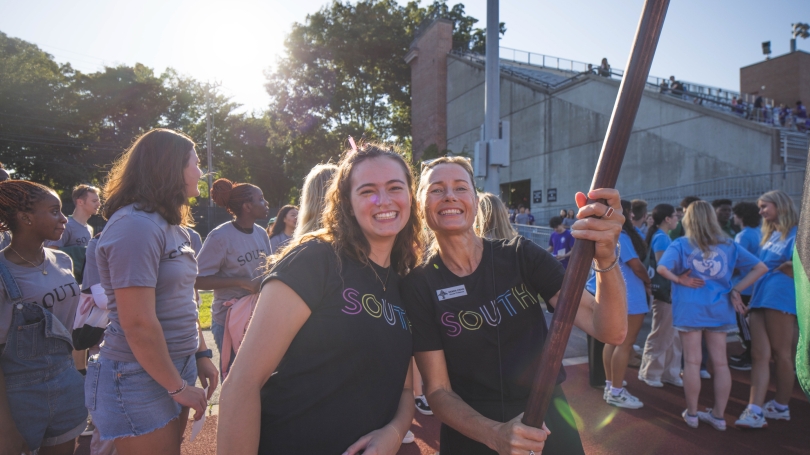
About the House System

One of the core goals of the House system is to provide more continuity in the residential experience. 

Why the House System?

Houses promote intellectual engagement, community, and continuity. They increase student access to members of the faculty in residential spaces, build community by creating opportunities for enhanced social ties and shared experiences in the residential system, and respond to the long-standing call from students for more continuity in their residential experience.

For many years, students and young alums have expressed frustration with how many times they've moved across campus due to variations in their D-plan. They've told us they haven’t known anyone on their floors and have treated their room assignment as “just a place to sleep.” 

Older alumni have reflected how much they appreciated living in the same location from year to year. 

Everyone Has a House

Every undergraduate student is affiliated with a House Community regardless of where you live. As a House member, you will always be welcomed and encouraged to participate in all House programs and activities no matter where you may live in your time at Dartmouth.

House Community Affiliation

One of the primary goals of the House Community program is to build communities that integrate members from many groups across campus in order to foster a deeper sense of connection and belonging. As such, the House Communities include undergraduate and graduate students, as well as faculty, staff, and post-doctoral scholars. 

Affiliation processes vary by group. 

  • All undergraduate students are randomly assigned to a House prior to their first year at Dartmouth. 
  • Graduate students in Guarini School of Graduate & Advanced Studies, Thayer School of Engineering, and Geisel School of Medicine students in the Masters of Public Health program are also automatically affiliated with a House Community during the fall term after arrival at Dartmouth. Graduate students who wish to affiliate with a House who are not already may contact Residential Education at Residential.Education@dartmouth.edu
  • Post Doctoral Scholars are identified ahead of the fall term after arrival, particularly those affiliated with the School of Arts & Sciences, Guarini School of Graduate & Advanced Studies, or the Thayer School of Engineering. 
  • Faculty - Faculty who serve in a pre-major advising role are assigned to a House Community by the advising team in the Division of Undergraduate Education. As a faculty member, if you wish to be affiliated with a House and are not currently, please complete the form below.
  • Staff - If you are interested in joining a House Community, please complete the form below to indicate your interest!

Staff and Faculty - Affiliate Here!

More about this form: A minimum of 2 times per term, the Office of Residential Education will review this list to ensure new House affiliates are connected with their House Community team, and are added to the newsletter distribution list so that you are informed about ways to engage.

House Leadership

Each of the six House Communities is co-lead by a team of Residential Education professional staff members and a House Professor who lives nearby. Together, the House Professor, Assistant Director, and Program Administrator develop community building opportunities for and with students. In addition, each House Community team includes four graduate Resident Fellows and a team of Undergraduate Advisors (UGAs).

House Activities

You can participate in all House activities, including dinners and events at your House Professor’s residence. Being a member of a House doesn’t determine your schedule, and it doesn’t change any of the other ways in which you’re involved in campus life and student organizations.

House Community Newsletters

Each House Community sends a weekly newsletter to all House affiliates to share information about events, initiatives, and opportunities to build community. 

In the Summer of 2025, the House Communities redesigned our weekly newsletters and established a centralized system for maintaining lists of House affiliates across campus. Our team in Residential Education, in partnership with our colleagues in the Offices of Communications and Student Affairs Information Systems, developed best practices for our revitalized newsletters and conducted a thorough review and consolidation of all houses'  newsletter distribution lists. 

As with any major information migration, if we may have inadvertently missed your name, please let us know. We want to be sure you are receiving the newsletter and hearing about the happenings in your House Community! Please email Residential Education if you have any questions about newsletters (Residential.Education@dartmouth.edu).

First-Year House Assignments

First-year undergraduate students receive their randomly assigned house memberships in the summer when they receive their room assignments. First-year students live with other first-years affiliated with their House Community unless they live in a Living Learning Community where roommates will have membership in the same House. All first-year students are encouraged to engage in House Community activities, and then move into their House Community residences from their second year onward.

House Centers

House Centers serve as "living room space" for their House, providing flexible, open space for House members to hang out, study, meet, or to use for House gatherings. House Center include:

  • House Center A (a.k.a. The Onion) - South House
  • House Center B (a.k.a. The Cube) - Allen House & School House
  • Occom Commons - North Park House
  • Brace Commons - East Wheelock House
  • Fahey Lounge - West House